
The Playoff Strength Plan Every Ice Hockey Coach Needs
By the time playoffs start, nobody is trying to get stronger anymore.
What separates teams now is who can still skate the same way in Game 6 that they did in October.
Tracking data across a full professional hockey season shows that players don’t lose strength in a traditional sense. What drops is how efficiently they can use it. Jump height, force production, and movement mechanics all decline as the season progresses, with the biggest changes showing up in the late phase.
That’s accumulated fatigue sitting in the system.
And if your strength work doesn’t adjust to that reality, it starts working against you. This is exactly where CoachThem helps coaches stay intentional, keeping practices aligned with performance instead of adding unnecessary load.
What Actually Changes In Playoff Hockey
Playoff hockey increases the density of high-intensity actions within each shift.
A standard shift already requires repeated bursts of maximal skating, typically 30-80 seconds, with nearly 50% of movement occurring at high intensity. What changes in playoffs is how those efforts stack.
Instead of isolated high-speed actions followed by clean recovery, players are forced into repeated sprint sequences with incomplete recovery, which is one of the most demanding physiological patterns in hockey.
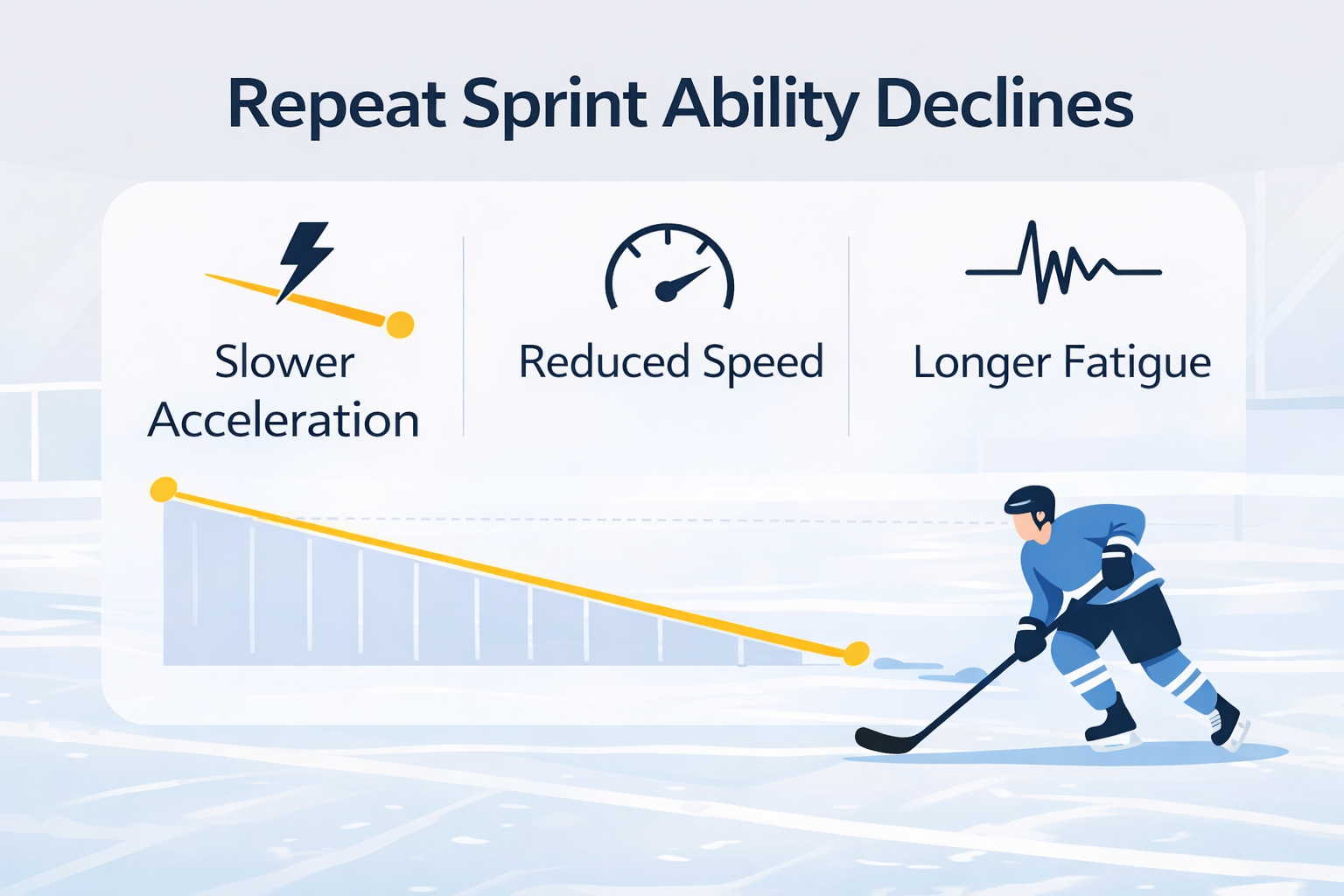
As the game progresses, muscle glycogen is progressively depleted, lactate levels remain elevated between shifts, and recovery efficiency drops. By the third period, both skating speed and repeated sprint ability are measurably reduced .
This is where performance changes.
Players lose the ability to produce force quickly and repeatedly. Acceleration becomes less efficient, transition speed drops, and high-intensity efforts become harder to reproduce shift after shift.
That's a decline in repeat sprint ability and neuromuscular output, which are the two qualities most closely tied to hockey performance late in games.
What A Playoff Strength Plan Is Trying To Do
At this point in the season, it’s important to maintain the qualities that already exist.
The focus is on three things: how quickly force can be produced, how efficiently players move, and how consistently they can repeat high-intensity efforts.
Maximal strength itself remains relatively stable, even when training volume is reduced. That is not where performance drops.
What changes first are the more sensitive elements of performance. Under fatigue or poorly managed training, braking ability and eccentric control begin to decline, which directly affects how players stop, change direction, and stabilize under pressure.
That aligns with what shows up on the ice.
How To Structure Strength Work During Playoffs
Late in the season, fatigue is driven primarily by training volume, not intensity. The goal is no longer to accumulate work, but to maintain output without adding load the body cannot recover from.
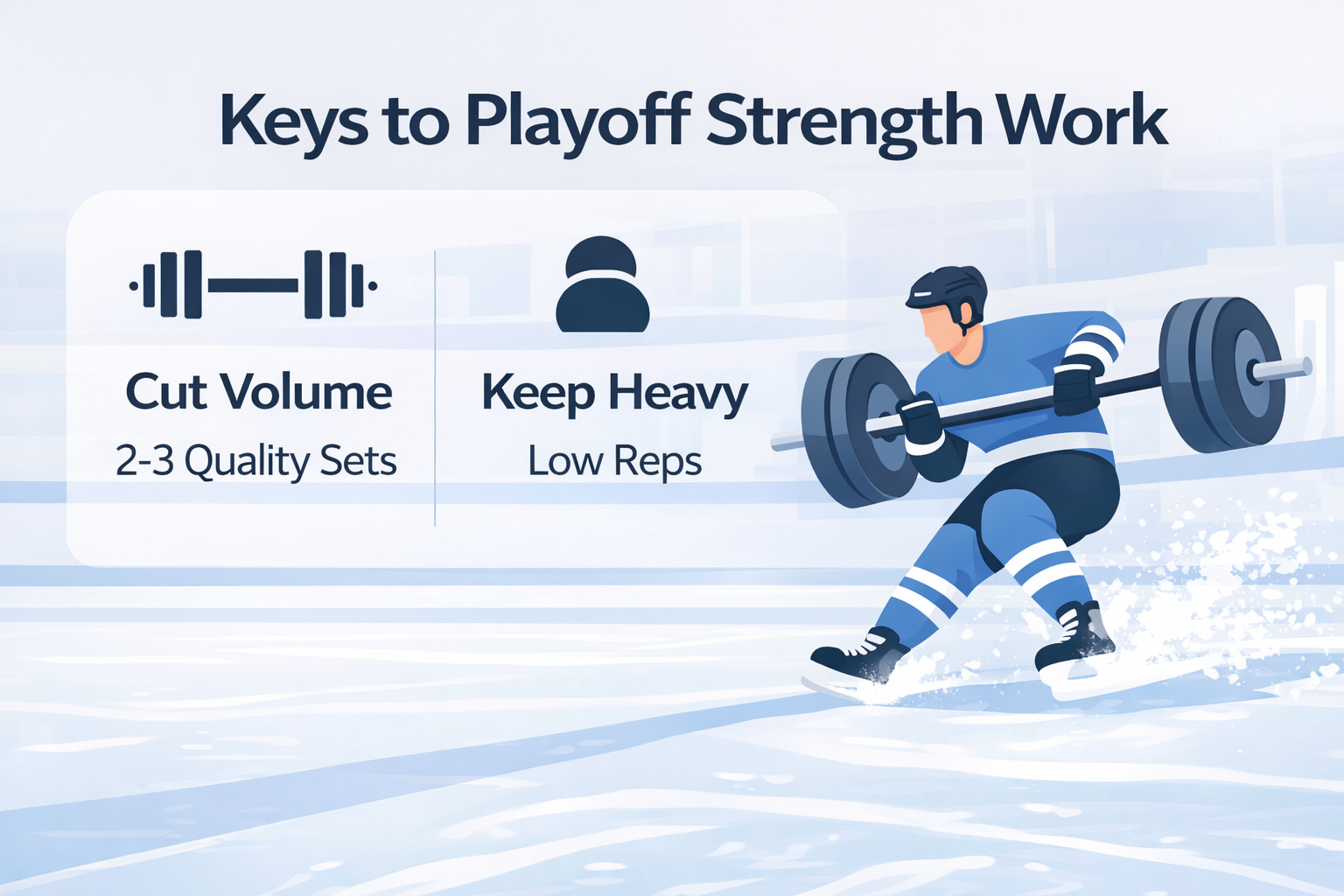
That means reducing total sets and removing unnecessary accessory work while keeping the session focused. Instead of multiple exercises and four to five working sets, a playoff session should be built around two to three quality sets, one primary lower-body lift, one unilateral movement, and a short power component.
The intent of the session stays the same, but the total fatigue cost drops significantly.
If players are leaving the gym feeling worked or drained, the volume is still too high.
Keep Strength Work Heavy Enough To Matter
A common mistake at this stage is lowering the load and increasing reps, turning strength work into conditioning. That removes the stimulus the nervous system needs to stay sharp.
Strength work should remain low-rep and controlled, with enough load to require force production without pushing sets to failure. The objective is not to create fatigue, but to maintain neuromuscular output.
You are not trying to exhaust the system. You are keeping it responsive.
Every Session Needs A Power Element
Explosiveness is one of the first qualities affected by fatigue, and it directly impacts skating, transitions, and puck battles. Removing power work does not make players fresher; it reduces their ability to generate speed.
Each session should include a short block of explosive work such as jumps, lateral bounds, or med ball throws. These should be performed in low volume, with full recovery between efforts, and without turning them into conditioning.
As soon as execution slows or quality drops, the work should stop.
Respect The 48-hour Window Before Games
In playoff schedules, timing becomes more important than programming.
Heavy lower-body work within 48 hours of a game does not contribute to performance. It carries residual fatigue into the game, which shows up as slower acceleration, delayed reactions, and reduced sharpness early in shifts.
A simple weekly structure is enough. The day after a game is used for recovery and light movement. A short strength session is placed two to three days before the next game. The day before competition is reserved for activation, not fatigue.
When players feel heavy at puck drop, the issue is almost always in the timing of the previous sessions.
The Overlooked Piece: Stopping Ability
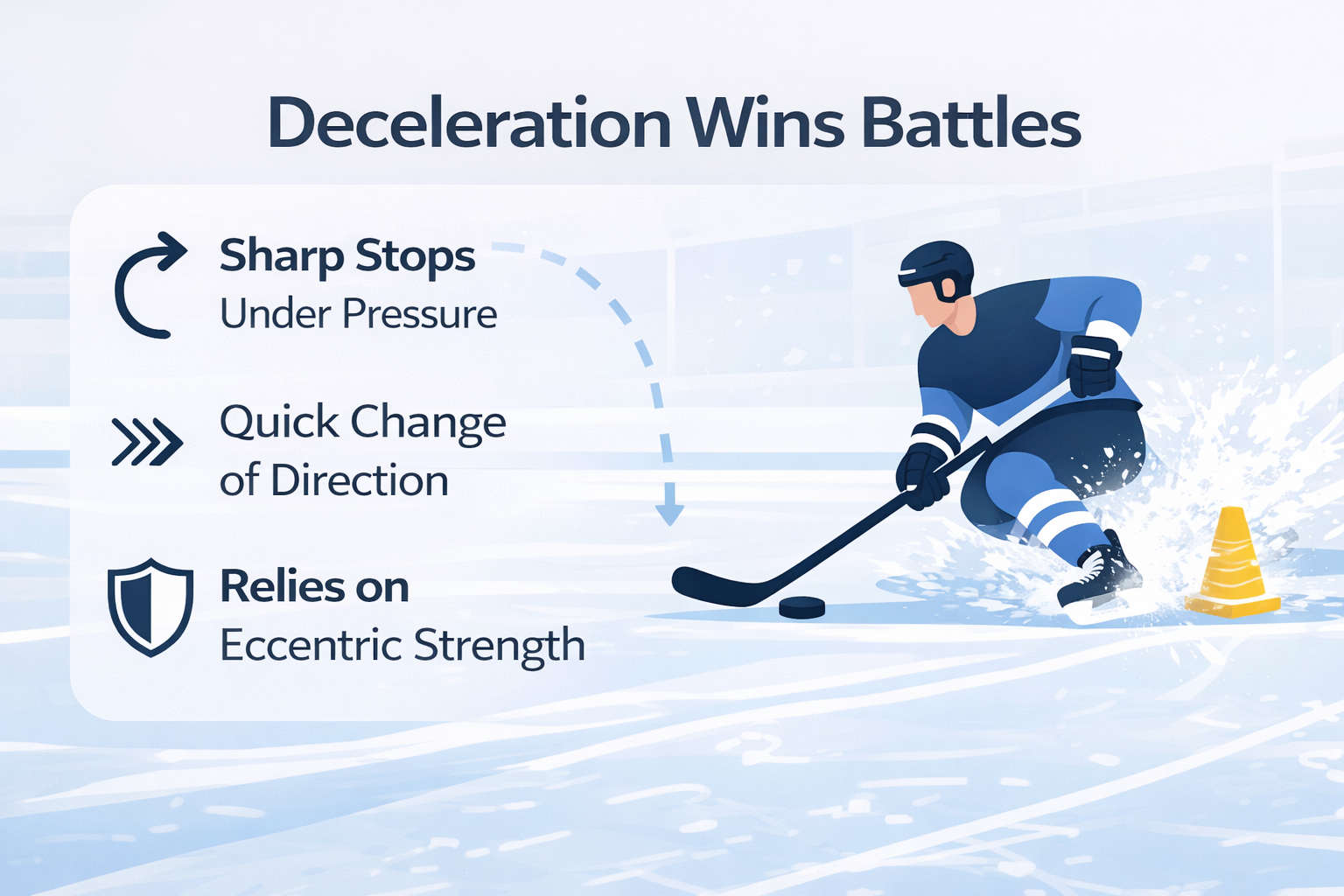
Most programs emphasize acceleration, but playoff hockey is often decided by deceleration.
The ability to stop, control space, and re-accelerate under pressure is critical in puck battles and defensive play. These actions rely heavily on eccentric strength, which is also one of the first qualities affected by fatigue. High-intensity decelerations place significant eccentric load on the system and are closely linked to fatigue and muscle damage .
On the ice, this shows up as overskating pucks, losing positioning, and struggling to recover on second efforts.
To maintain it, small amounts of targeted work are enough. Controlled single-leg exercises, stick-and-hold bounds, and short acceleration-to-stop drills help preserve braking ability without adding excessive load.
The goal is not to build it further, but to keep it from dropping.
Recovery Is Not Separate From Performance Anymore
At this stage of the season, recovery becomes part of the system. Fatigue does not come only from games, it builds from everything layered together across practices, travel, and competition load. Research shows that accumulated physical and mental fatigue directly impacts decision-making, coordination, and overall performance if not managed properly.
When recovery is structured, performance stabilizes.
What actually works is simple but intentional. Light movement the day after games instead of full rest, consistent sleep instead of occasional recovery days, and keeping the body active without adding unnecessary stress. Players need better turnover between effort and recovery.
By playoffs, players are not missing anything physically. They are carrying everything they have built. The role of the coach shifts from adding more work to protecting what is already there. That means cutting what does not transfer, keeping what maintains sharpness, and focusing on output rather than volume.
Because at this stage, the teams that last are the ones that arrive with the least resistance between what they have and what they can actually deliver on the ice.
At this stage, structure is what keeps performance usable. Using CoachThem, coaches can organize their practice plans, manage training load, and ensure every session aligns with performance demands throughout playoffs.

Frequently Asked Questions
What changes in hockey performance during playoffs?
During playoffs, performance declines are primarily caused by accumulated fatigue rather than loss of strength. Players struggle with repeat sprint ability, acceleration, and decision-making due to reduced recovery between high-intensity efforts.
How should strength training change during hockey playoffs?
Strength training during playoffs should focus on maintaining power and neuromuscular output while reducing overall volume. Sessions should be shorter, more focused, and avoid unnecessary fatigue.
How often should hockey players train strength during playoffs?
Most teams benefit from 1-2 short strength sessions per week, scheduled 2-3 days before games. Heavy training within 48 hours of a game should be avoided to prevent performance drops.
Why is fatigue management important in playoff hockey?
Fatigue directly affects skating speed, reaction time, and decision-making. Managing fatigue allows players to maintain performance across all periods and games, especially in high-pressure playoff situations.
What is the most important physical quality in playoff hockey?
Repeat sprint ability and power output are critical. Players must be able to produce high-intensity efforts consistently, even under fatigue, to maintain performance late in games.

Now available on iOS — access your saved practice plans on the go.
Build Better Practices — Faster
Trusted by NHL, PWHL, and youth coaches across the world.
Start Your 10-Day Free TrialAlready have an account? Log in
Know other coaches who’d love CoachThem?
Join CoachThem Rewards and earn commissions for every referral.
Written by the CoachThem Team, March 26 2026
Recommended Posts
Practice Like A Pro 9.0
Hockey practice drills focused on breakouts, blue line activation, and small area games. Help your players improve decision-making, puck support, and compete level in every practice.

The Playoff Strength Plan Every Ice Hockey Coach Needs
Playoff hockey demands a different approach to strength and performance. Learn how to structure training, manage fatigue, and maintain speed, power, and efficiency when it matters most.

Nick Turcotte’s Stickhandling Drills for Better Puck Control and Peripheral Vision
Learn head-up stickhandling drills from Nick Turcotte designed to improve peripheral vision, puck control, and on-ice awareness. These hockey skill drills help players develop feel for the puck while keeping their head up and reading the play.