Forechecking Systems & Drills: Master Elite Pressure Like the Minnesota Wild
Why Forechecking Wins Games
Elite teams like the Minnesota Wild and Montreal Canadiens don't pressure randomly - they execute coordinated systems where every forward knows their role. This systematic execution separates championship teams from the rest. In this guide, we break down the forechecking systems elite coaches use, the three drills that develop them, and how to implement them into your practice.
Part 1: Forechecking Systems Explained
The Three Forward Roles: F1, F2, F3
F1 (First Forward): Primary Pressure
- Applies immediate pressure on the puck carrier
- Angle them to the boards (away from the middle ice)
- Forces quick decision-making under pressure
F2 (Second Forward): Support and Seal
- Cuts off passing lanes, especially middle ice
- "Seals" behind F1 to prevent escape plays
- Anticipates F1's pressure and supports
F3 (Third Forward): Safety Valve
- Covers breakout options and odd-man rushes
- Stays higher in the zone as defensive insurance
- Reads and adjusts based on play development
From Minnesota Wild practice analysis: "They sustain pressure by timing the three forwards on the puck placement. If F1 is there, F2 is sealing behind, and F3 is coming back through the middle."
Communication: Non-Negotiable
Elite forechecking requires constant communication. Essential callouts include:
- "I've got the puck!" (F1) "
- I've got middle!" (F2)
- "I'm high!" (F3)
Without communication, players shadow each other and leave gaps.
Part 2: Three Proven Drills
Drill 1: Progressive Pressure (1v5 → 2v5 → 5v5)
From Montreal Canadiens Practice - Drill #4: Breakout vs Forecheck
.png)
This drill develops forechecking timing under increasing pressure levels.
Setup: 30-45 second reps with three progressive rounds
Round 1: 1v5 (Light Pressure)
- Only F1 applies pressure
- Breakout team focuses on clean exit
- Teaching focus: Quick decision-making, building confidence
Round 2: 2v5 (Moderate Pressure)
- F1 and F2 apply coordinated pressure
- Emphasizes communication and preventing middle passes
- Breakout team faces realistic pressure
Round 3: 5v5 (Full System)
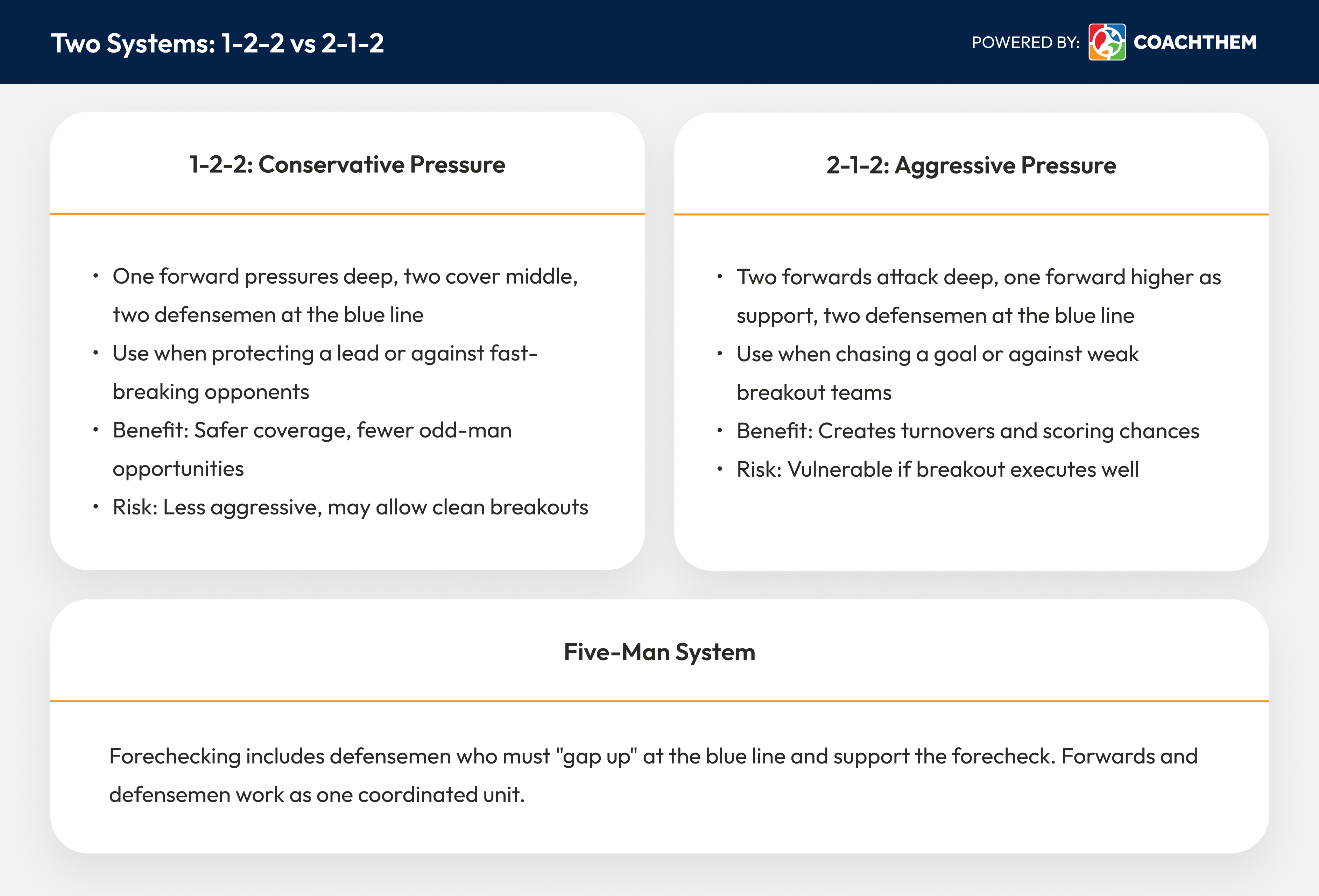
- All five forecheckers execute your chosen system (1-2-2 or 2-1-2)
- Game-speed execution
- Teaching focus: System discipline under fatigue
As Montreal states: "Build up your whole breakout for the last part and, hopefully, don't stay in your dzone."
Weekly use: 2-3 times per week
Drill 2: Breakout, Forecheck, Rush (Full-Ice Transition)
From Minnesota Wild Practice - Drill #6: Breakout, Forecheck, Rush
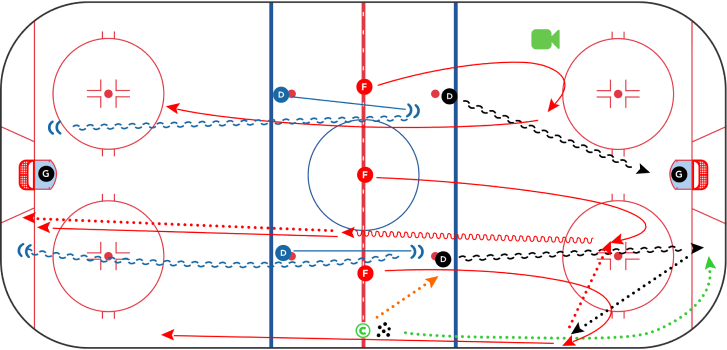
This is the closest simulation to actual game forechecking. It teaches the complete cycle: breakout execution, pressure timing, turnover recovery, and transitions.
Setup: Full-ice action starting with breakout, flowing through forecheck
Phase 1: Breakout Defensive team exits using their standard breakout structure.
Phase 2: Forecheck Execution
"The way they are doing their forecheck is efficient. They sustain pressure by timing the three forwards on the puck placement."
- F1 pressures immediately
- F2 and F3 position based on breakout direction
- Puck carrier holds while F2 and F3 are close to the puck line
- Breakout team goes to the opposite corner under pressure (rim or across)
- If F1 arrives first: F2 seals behind, F3 comes through middle = complete coverage
Phase 3: Outcome
- Turnover created: Forecheck team counter-attacks
- Breakout succeeds: Transition to neutral zone play
Key teaching points:
- Pressure timing matters more than intensity
- Positioning (especially F2 and F3) determines success
- Communication between all five players is critical
"On the rush, they are attacking the heels, working on fundamentals that the Minnesota coaches are asking."
Weekly use: 1-2 times per week as a primary forechecking drill
Drill 3: Puck Placement Under Pressure (2v1)
From Montreal Canadiens Practice - Drill #3: Rush 2v3 Working on Puck Placement
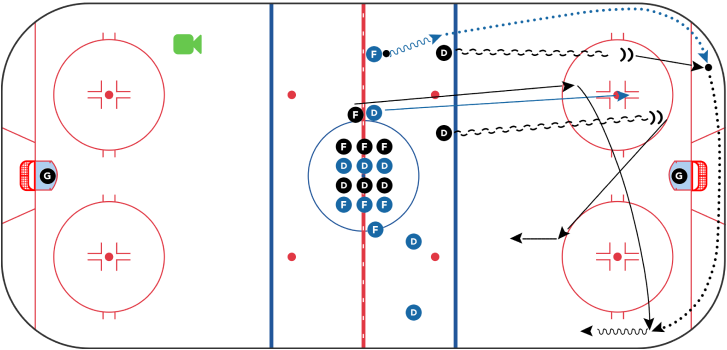
This drill forces poor puck placement that creates recovery opportunities.
Setup:
- Two forwards vs. one defenseman in the offensive zone
- Defenseman receives breakout pass from red line
- Two additional defenders at the goal line are ready to retrieve
Execution:
- F1 closes quickly on the puck carrier
- F2 cuts off passing lanes
- Puck carrier must place puck under pressure
- D2 retrieves and breaks out
Teaching focus:
"At first, you'll be surprised how many players struggle to place the puck and let it die in the corner. It's a critical factor to work on for your forecheck."
Players typically panic and turn it over, shoot poorly, or make inaccurate passes. Your coaching goal: develop intentional, consistent puck placement.
This drill teaches both sides - forechecking players learn what pressure creates, while breakout players develop puck placement techniques under real pressure.
Weekly use: 1-2 times per week as a supplementary skill drill
Part 3: Weekly Practice Structure
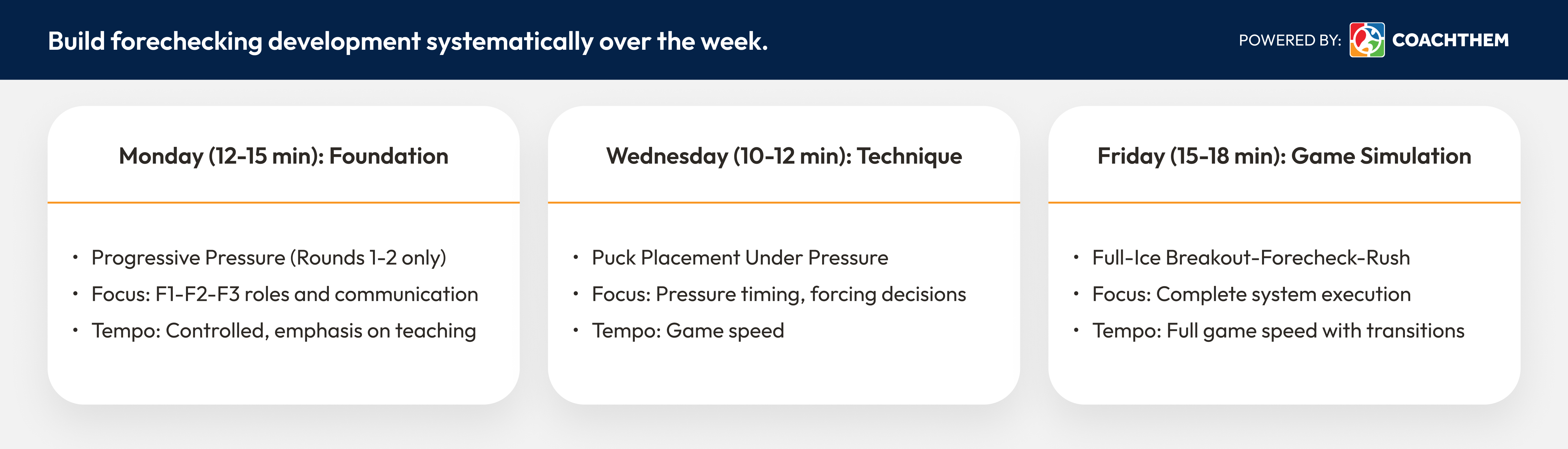
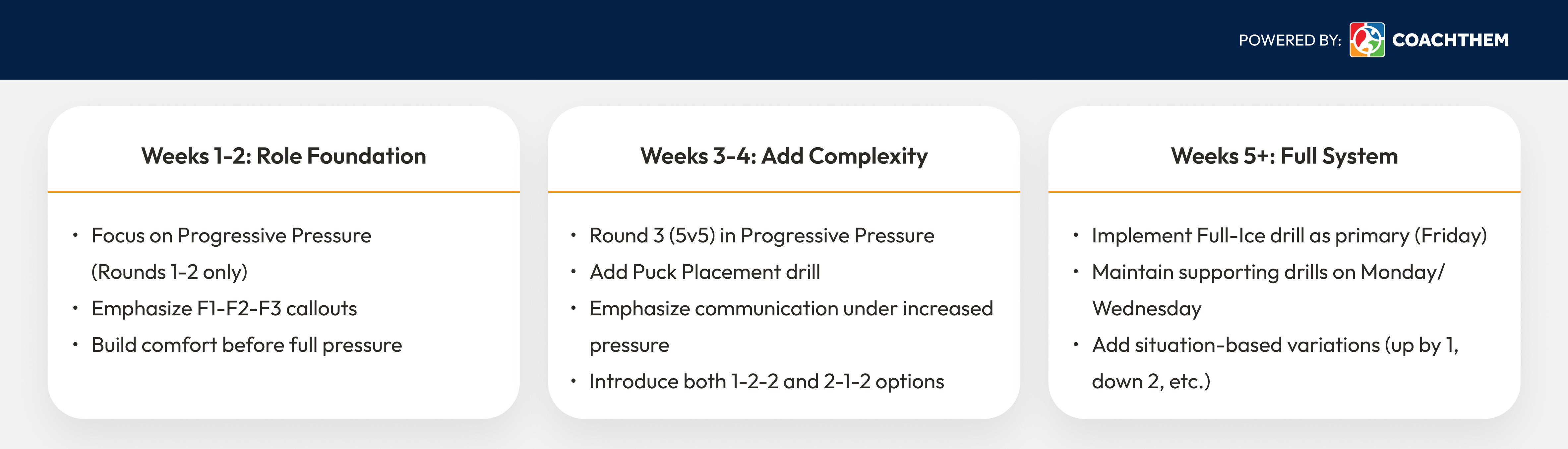
This structure builds throughout the week. Monday establishes roles. Wednesday develops technique. Friday tests complete execution.
4-Week Progression
Measuring Success
Early signs your team is developing elite forechecking:
- Consistent communication (you hear the callouts)
- F1 pressures with purpose (not wild rushing)
- F2 cuts passing lanes (not following F1)
- Fewer odd-man rushes against your team
Advanced signs:
- Forechecking creates turnovers in the offensive zone
- System discipline is maintained under fatigue
- Players adjust pressure based on opponent response
- Smooth transitions from pressure to defense
Getting Started
Elite forechecking begins with deliberate and systematic practice.
Your action plan:
- Choose your primary system (1-2-2 for safety, 2-1-2 for aggression)
- Start with the Progressive Pressure drill (simplest to teach)
- Add Puck Placement drill mid-week (technique focus)
- Finish Friday with Full-Ice drill (complete system)
- Track progress over 4-6 weeks
Use CoachThem's practice planning platform to organize these drills into a structured progression. Download the CoachThem iOS app for mobile access to all drill notes and coaching points during practice.
The difference between average pressure and elite forechecking is simple: system and execution. Your team can execute like the Minnesota Wild.

November 7, 2025
Written by the CoachThem Team
Ditch the pen and paper! Sign up or log in to create professional digital drills in minutes.
Join CoachThem Rewards to earn money by referring other coaches and growing our coaching community!