What Hockey Can Learn from Lacrosse Spacing
Hockey has traditionally explained offensive success through speed, skill, and execution. Teams that skate faster, move the puck efficiently, and win individual battles tend to generate more scoring chances. At lower levels, that separation is clear. At higher levels, it disappears. As defensive systems become more structured and consistent, time and space must be created.
This is where many hockey teams struggle. Players are technically capable, systems are in place, and execution in drills looks clean, but once the game tightens, offensive zone spacing breaks down. The puck carrier runs out of options, support arrives late or in the wrong lanes, and possessions end without creating meaningful pressure.
Lacrosse has approached this problem differently. Rather than relying on instinct or individual reads, lacrosse spacing principles are taught as a system built on structure, timing, and repeatable rules. Concepts such as triangle spacing, adjacent replacement, and off-ball movement are introduced early and reinforced consistently. The result is an offensive structure that remains connected under pressure while forcing the defense to move, rotate, and make decisions.
The gap between how the two sports approach spacing is becoming increasingly relevant in modern hockey, particularly as teams look for ways to generate offense against well-organized defensive coverage.
The Problem With Hockey Spacing in the Offensive Zone
In hockey, offensive zone spacing is often tied directly to puck movement rather than off-puck structure. Players are taught where to position themselves within a system, but less emphasis is placed on how spacing should evolve as the play develops. Once the puck enters the offensive zone, structure frequently becomes static. Wingers hold their lanes, defensemen stay high, and support options become predictable.
This leads to a common breakdown. The puck carrier reaches the wall or the top of the zone and is left with one option instead of two. Without layered puck support, defenders can close space aggressively without being forced to adjust. Plays become contained rather than expanded.
This issue is a structural limitation in how spacing is taught. When spacing is treated as positioning rather than movement, it becomes easier for the defense to maintain its shape.
Lacrosse Spacing Principles: A System Built on Movement
Lacrosse spacing principles are designed to keep the offense connected while constantly shifting the defense. Rather than focusing on fixed positions, lacrosse systems emphasize relationships between players. The most common framework is triangle spacing, where players maintain three-point support structures that provide multiple passing options at all times.
In addition to triangle spacing, lacrosse offenses rely heavily on adjacent replacement. When one player attacks a seam or initiates a dodge, the nearest teammate immediately fills the space that was vacated. This ensures that the structure remains intact and that the puck or ball carrier always has an outlet.
Off-ball movement is a primary driver of offense. Players are expected to move before the play reaches them, adjusting their position based on the movement of teammates and the behavior of defenders. This continuous motion forces defensive coverage to shift and creates openings that can be exploited quickly.
These principles combine to form a system where spacing is dynamic, interconnected, and consistently maintained under pressure.
Translating Lacrosse Spacing to Hockey Offensive Zone Play
The most effective way to apply lacrosse spacing concepts in hockey is by adopting the underlying rules that govern movement and support.
Triangle spacing can be directly translated into hockey puck support. In the offensive zone, the puck carrier should consistently have at least two passing options: a safe outlet and a more aggressive option that can create a scoring opportunity. Maintaining these triangular support structures allows for quicker puck movement and reduces the likelihood of turnovers under pressure.
Adjacent replacement can be applied to common hockey actions such as cycling, driving the net, or walking the blue line. When a player leaves a position to attack, another player must fill that space immediately. This prevents the offensive structure from collapsing and ensures that passing lanes remain available.
Off-puck movement has to be part of the play, not something players choose to do. Players away from the puck need to actively create new passing lanes by adjusting their position in anticipation of the next play. This includes movements such as rotating high to the slot, sliding into weak-side space, or supporting underneath the puck carrier.
When these principles are applied consistently, offensive zone spacing becomes more fluid and less predictable. Defenders have to move and respond instead of just sitting in position.
The Role of Small-Area Games in Teaching Spacing
Spacing is difficult to teach through static drills. It must be learned in environments that replicate the pressure and constraints of a game. Small-area games are one of the most effective tools for teaching offensive zone spacing because they force players to make decisions in limited space and time.
By reducing the size of the playing surface and increasing the frequency of puck touches, these games create conditions where spacing, support, and decision-making are constantly tested.
In small-area environments, players quickly learn that standing still or arriving late to support results in lost possession. Conversely, early movement, proper spacing, and quick support lead to sustained offense. These are the same principles that define effective lacrosse spacing.
Practical Application: Integrating Spacing into Practice
To implement lacrosse spacing principles in hockey, coaches should focus on creating constraints that encourage movement and support rather than prescribing exact positioning.
Drills should emphasize maintaining triangular support, replacing space after movement, and creating passing options before pressure arrives. For example, small-area games can include rules that require a minimum number of passes involving three different players, or conditions where goals only count if they are preceded by off-puck movement.
Instead of instructing players where to stand, coaches should focus on when to move and how to support.
Video review can also be used to highlight moments where spacing either supports or limits offensive play. By showing players how their positioning affects the options available to teammates, coaches can build a deeper understanding of spacing as a collective responsibility.
In a 3v3 small-area game, players are forced to constantly adjust their positioning to stay connected to the puck, which naturally creates triangle support and multiple passing options under pressure. Small-area games are specifically designed to simulate real game situations and increase puck touches and decision-making intensity.
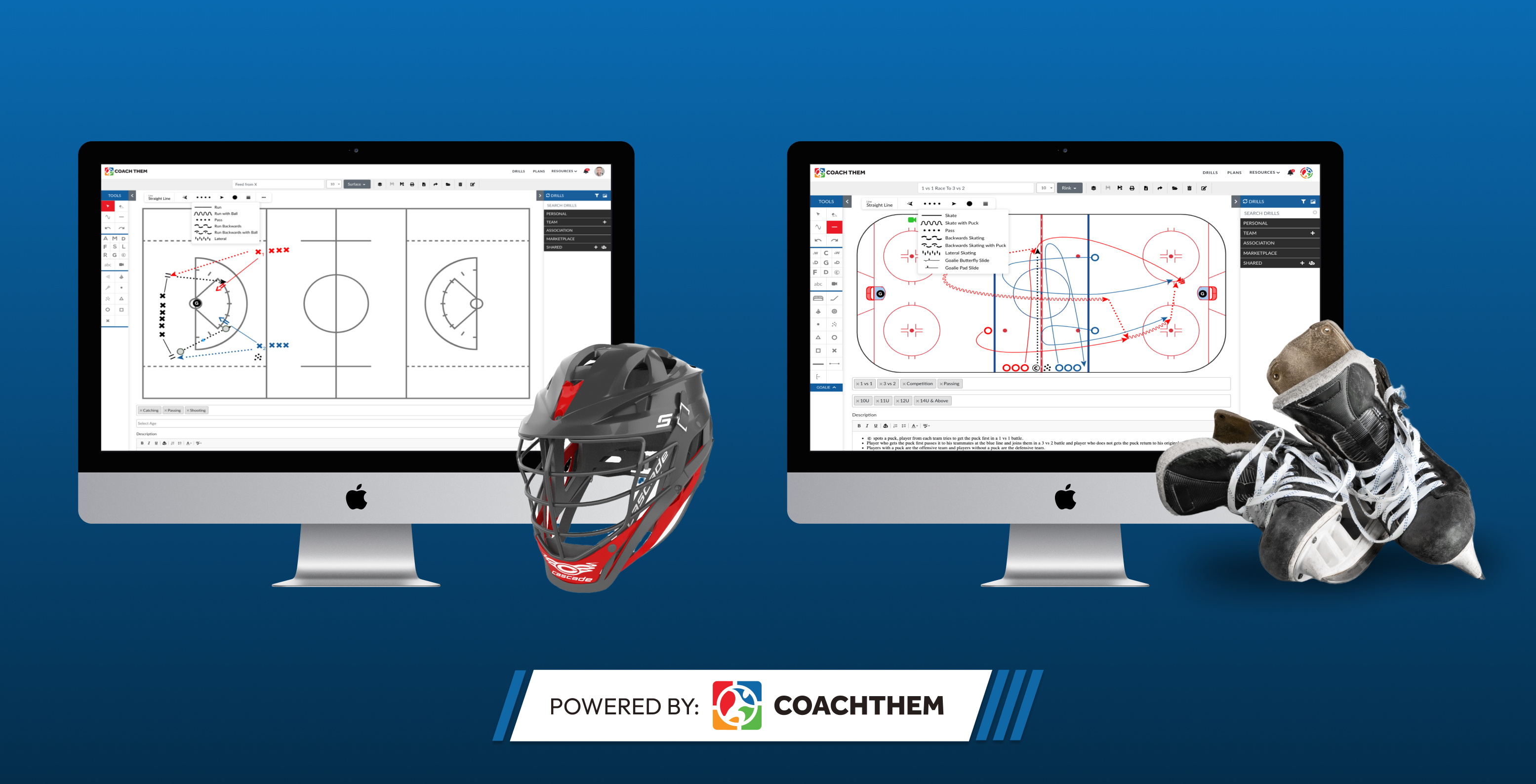
From a CoachThem perspective, this is exactly how spacing should be implemented in practice design. Instead of drawing fixed positions, the coach builds constraints (limited space, quick transitions, support rules) that force players to move, replace, and recreate options continuously. CoachThem allows you to map these movement patterns visually, so spacing becomes a repeatable behavior rather than something players try to improvise.

Why Spacing is Becoming a Competitive Advantage
As hockey continues to evolve, the ability to create and maintain offensive zone spacing is becoming a key differentiator. Teams that rely solely on speed and individual skill will struggle against structured defensive systems that limit time and space.
By contrast, teams that understand spacing as a system can generate offense more consistently. They are able to maintain puck possession under pressure, create higher-quality scoring chances, and force defensive breakdowns without relying on individual plays.
Lacrosse provides a clear example of how spacing can be taught, practiced, and executed as a repeatable system. By adopting these principles, hockey coaches can address one of the most common limitations in offensive play and build a more effective approach to creating time and space.
CoachThem makes that process easier by giving coaches a way to turn spacing concepts into clear, visual practice plans. Instead of talking through movement patterns, coaches can map them out, build them into drills, and make them repeatable on the ice. If spacing is something you want your team to actually improve, it has to show up in the way you design practice.
Frequently Asked Questions
What is spacing in hockey?
Spacing in hockey is the way players position and move in relation to each other to stay connected offensively, create passing options, and make it harder for defenders to hold their structure.
How does lacrosse spacing apply to hockey?
Lacrosse spacing applies to hockey through shared offensive principles such as triangle support, adjacent replacement, and off-puck movement. These concepts help players stay connected and create better options under pressure.
Why is offensive zone spacing important in hockey?
Offensive zone spacing is important because it helps the puck carrier keep multiple options available, supports puck possession under pressure, and creates better scoring chances against structured defenses.
What is triangle spacing in hockey?
Triangle spacing in hockey is a support structure where the puck carrier has two connected passing options, usually creating a safe outlet and a more dangerous attacking option.
What can hockey coaches learn from lacrosse spacing?
Hockey coaches can learn how to teach spacing as a repeatable system built on movement, support, and timing rather than leaving offensive structure to instinct once the puck enters the zone.

Now available on iOS — access your saved practice plans on the go.
Build Better Practices — Faster
Trusted by NHL, PWHL, and youth coaches across the world.
Start Your 10-Day Free TrialAlready have an account? Log in
Know other coaches who’d love CoachThem?
Join CoachThem Rewards and earn commissions for every referral.
Written by the CoachThem Team, April 2 2026
Recommended Posts
How Ice Hockey and Inline Hockey Develop Smarter Players
Explore how ice hockey and inline hockey work together to build smarter, more adaptable players through skill development, decision-making, creativity, and structured training.
Practice Like A Pro 11.0
Five simple and effective hockey drills coaches can use to build better habits, improve execution, create more puck touches, and keep practices competitive.
The 2026 NHLCA Global Coaches’ Clinic Returns With the Annual Drill Book
CoachThem is proud to support the 2026 NHLCA Global Coaches’ Clinic in Pittsburgh with the annual NHLCA Drill Book powered by CoachThem.