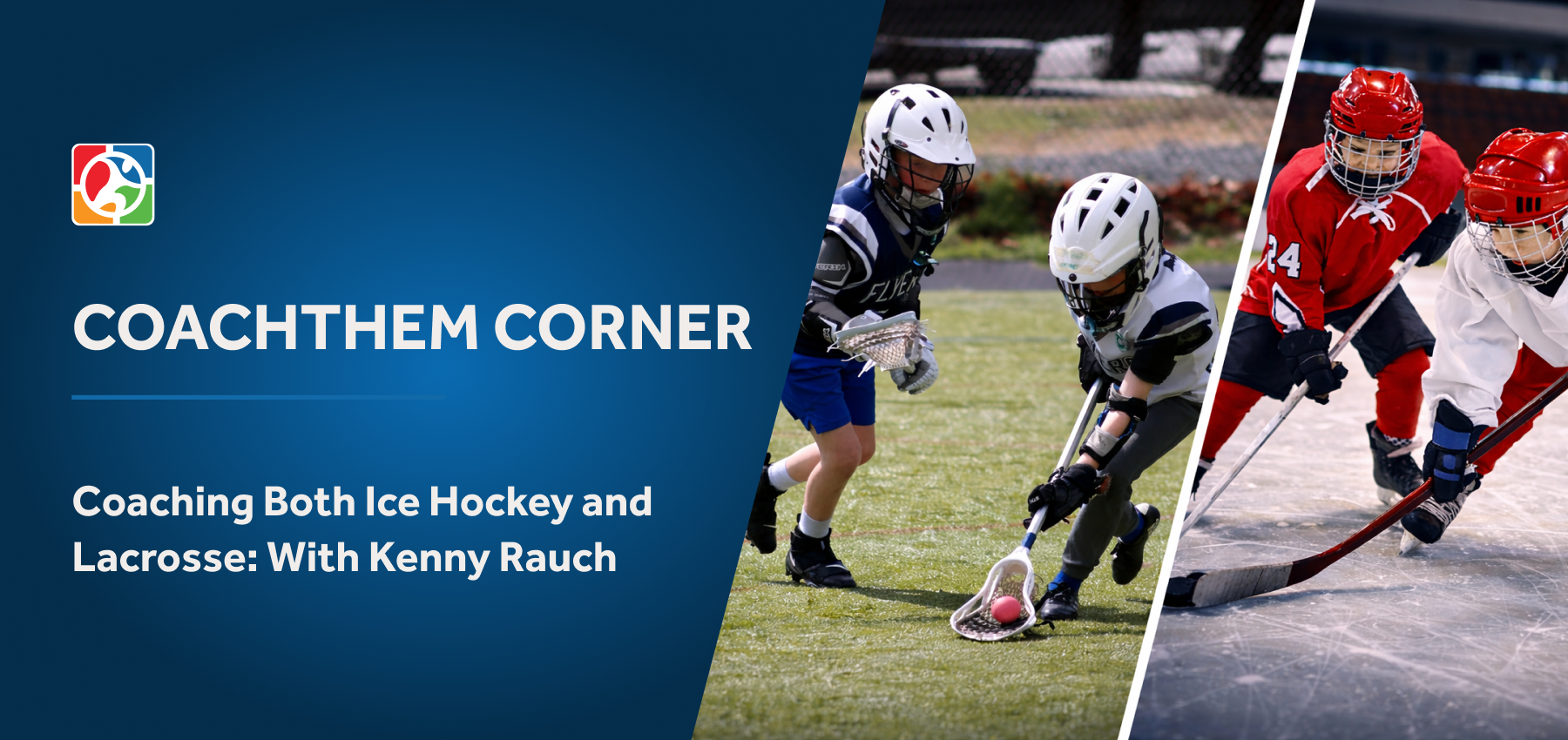
Coaching Both Ice Hockey and Lacrosse: How Kenny Rauch Uses CoachThem to Stay Organized and Develop Athletes
In today’s blog, we take a closer look at what it really means to manage multiple teams across different sports, and how coaches can stay organized, efficient, and consistent in their approach.
Kenny Rauch balances coaching duties across two rec-league hockey teams and two youth lacrosse teams. “I usually have one hockey practice and two lacrosse practices per week. That can change at times to 2 hockey/1 lacrosse or 2 and 2.”
During certain parts of the year he also assists with an American Collegiate Hockey Association (ACHA) club team, adding another one or two hockey sessions.
That means he can be on the ice or field five or six times a week while juggling more than 30 players per sport.
Managing multiple teams demands careful scheduling. Rauch notes that communication and organization with assistant coaches is crucial, especially because both sports use station-based practices with small-area games to maximize reps. Breaking the ice into multiple stations keeps athletes constantly moving, providing more puck touches and repeated skill executions. For Rauch, this structure works equally well on a lacrosse field. Staying organized also means coordinating with parents, ensuring young athletes are in the right place at the right time, as practice schedules often shift depending on ice or field availability.
“Using CoachThem helps me design or repurpose older practices to distribute to our coaching groups without wasting a lot of time.”
Cross-pollinating drills between sports
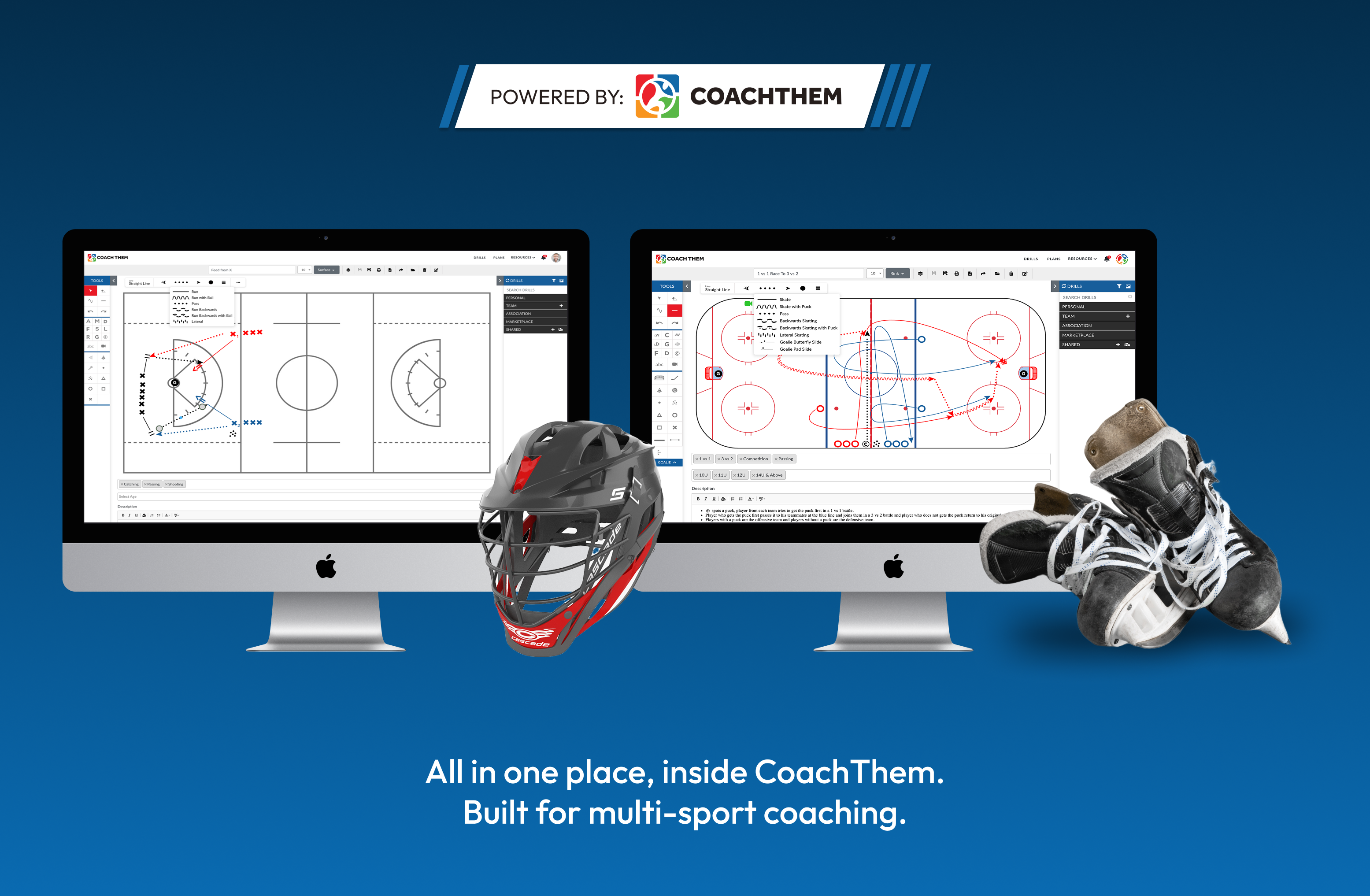
Rauch regularly adapts drills from one sport to the other. “100% we adapt drills from one sport to the other and sometimes it is the exact same drill.” Many core station-based games, such as 3-on-3 in a confined space or passing relays, translate seamlessly from ice to turf. He even copies diagrams directly in CoachThem.
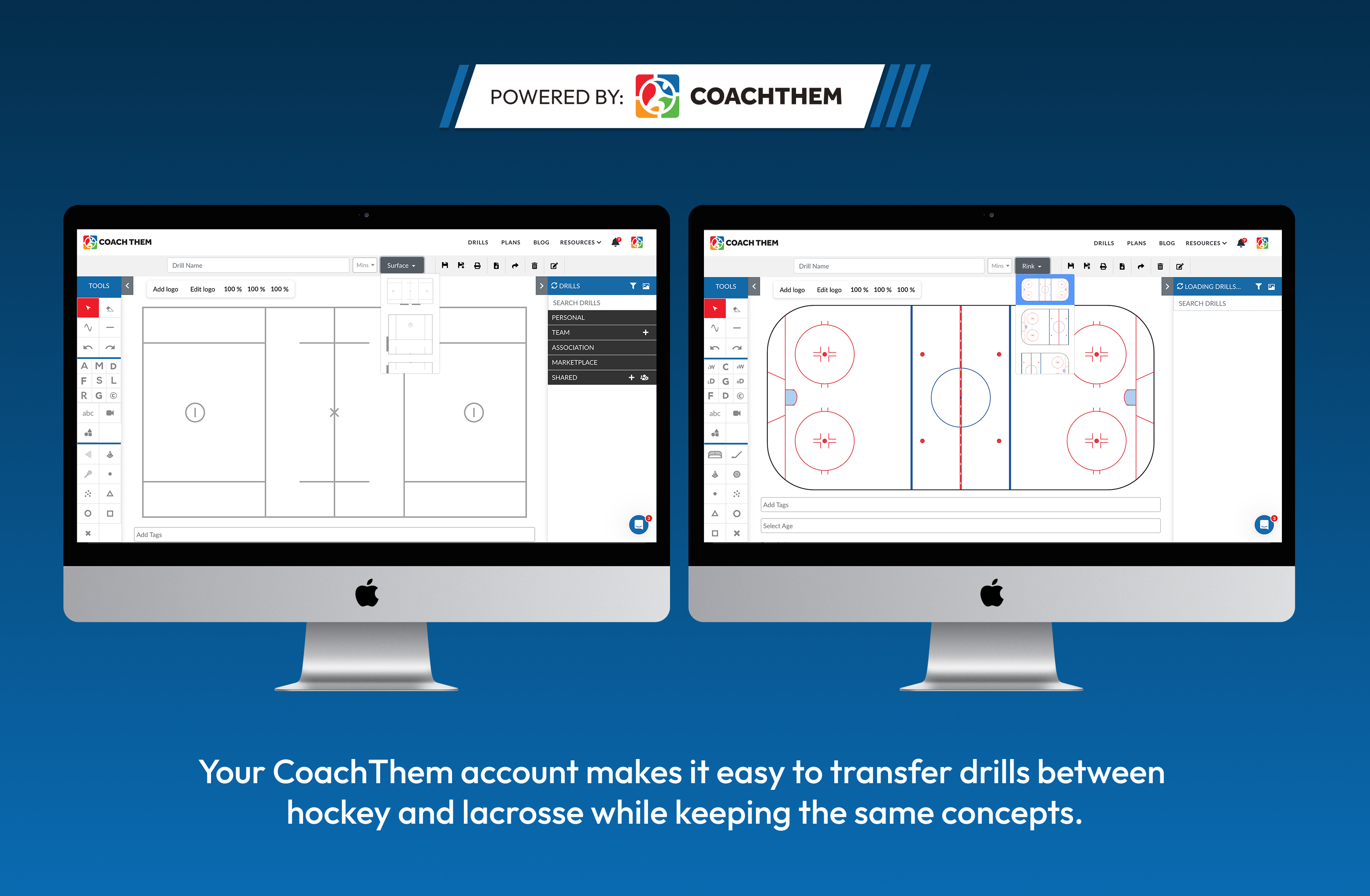
Because CoachThem allows users to change playing surfaces, he can duplicate a hockey drill and place it on a lacrosse field with minimal adjustments. This saves valuable planning time while giving athletes similar movement patterns and decision-making challenges across sports.
Cross-training also benefits athletes. Playing lacrosse can improve stick skills, hand-eye coordination, agility and spatial awareness, which transfers to hockey. Lacrosse’s lateral movement and quick changes of direction enhance footwork, while constant ball handling sharpens coordination. Conversely, the explosive skating and physicality of hockey can boost a lacrosse player’s strength and endurance. Combining these sports keeps athletes engaged, helps prevent burnout and develops a more well-rounded skill set.
A consistent coaching framework
Despite coaching different sports, Rauch uses a single framework: station-based practices and small-area games. In both hockey and lacrosse, he divides the surface into several stations where groups of players rotate through drills focusing on specific skills, skating or dodging, passing, shooting, and small-sided games. Small-area games create game-like pressure and force players to make quick decisions.
As Rauch mentioned: “Having been doing this for over 20+ years, I have a core set of games and stations that I know work well for player development and team development that live in my Coach Them Drill library!”. He adjusts rules or space to suit different age groups but rarely redesigns from scratch. For example, a puck-protection drill for 10-year-old skaters can be tweaked for college players by increasing physicality or restricting the playing area. Having a library of templates helps him build progressions, just as CoachThem suggests using base stations that can be edited week to week.
Player development across sports
Rauch believes coaching both hockey and lacrosse shapes his approach to player development. As a former director of youth hockey for USA Hockey, he emphasizes long-term athlete development over winning games. The crossover between hockey and lacrosse also fosters adaptability; athletes must process information quickly, react to opponents and use space creatively, skills that transfer between sports and build smarter players.
According to development resources, exposure to multiple sports enhances physical fitness, hand-eye coordination, agility and mental toughness. Cross-training reduces burnout and encourages creativity. Rauch leverages these benefits by encouraging his players to participate in both sports and by designing practices that share common principles.
How CoachThem fits in
CoachThem is central to Rauch’s workflow. He uses the platform to draw up hockey and lacrosse practices, organize station diagrams and share them with assistant coaches. The ability to change surfaces lets him duplicate a drill from the ice and place it on a lacrosse field without recreating it from scratch, this immediately resonated with his coaching style. By storing drills in a library, he can repurpose older plans and distribute them to coaching groups quickly, streamlining time management. This is particularly helpful when he has to juggle four or five practices in a week.
As he notes, “Coach Them fits in my process as I don't try to reinvent the wheel.” Instead, he relies on a core set of proven station-based games and uses CoachThem to tweak them for different age groups or sports. The platform’s collaborative features enable him to communicate practice plans to assistants and keep everyone aligned. For a coach managing multiple teams and sports, those efficiencies are invaluable.
Main lessons for coaches
- Station-based practices and small-area games remain one of the most effective ways to increase repetitions, keep players actively involved, and create more opportunities for individual teaching.
- It also helps to build a reliable drill library. Having a core group of drills and games that can be adjusted across age groups and even across sports makes practice planning more efficient and more consistent over time. Tools like CoachThem make that process easier by allowing coaches to save, update, and share diagrams quickly.
- There is also real value in the crossover between hockey and lacrosse. Many of the skills developed in one sport, including stick work, agility, decision-making, and spatial awareness, carry over well into the other. For coaches and athletes alike, that overlap creates more opportunities for development.
- Just as importantly, the focus should stay on long-term player growth rather than short-term results. Well-structured practices should build skill, creativity, and confidence while keeping athletes engaged and challenged.
- Finally, collaborative tools can save coaches a significant amount of time. When practice plans are easy to organize, adapt, and share with other coaches, it becomes much easier to manage multiple teams and maintain consistency across sessions.
Kenny Rauch’s experience shows what that can look like in practice. With a clear development framework, a strong library of proven drills, and the right digital tools, it is possible to coach multiple sports effectively without losing sight of what matters most: helping players improve.

Frequently Asked Questions
How can coaches manage practice planning for multiple sports?
Coaches managing multiple sports can save time by building a consistent practice framework, keeping a reliable drill library, and reusing proven station-based drills across teams. Staying organized with schedules, assistant coach communication, and shared practice plans also helps make weekly planning more efficient.
Can hockey and lacrosse drills be adapted across both sports?
Yes, many hockey and lacrosse drills can be adapted across both sports. Small-area games, passing relays, and decision-making drills often translate well because they develop similar skills like spatial awareness, quick reactions, and teamwork. Coaches can often repurpose the same practice concepts with only minor adjustments.
Why are station-based practices effective for player development?
Station-based practices are effective because they keep players active, increase repetitions, and create more opportunities for individual teaching. By dividing the surface into smaller stations, coaches can maximize puck or ball touches, maintain engagement, and build game-like situations that support skill development.
What are the benefits of playing both hockey and lacrosse?
Playing both hockey and lacrosse can help athletes improve hand-eye coordination, agility, stick skills, decision-making, and overall athleticism. The crossover between the two sports also keeps athletes engaged, encourages creativity, and can help reduce burnout by giving players different ways to compete and develop.

Now available on iOS — access your saved practice plans on the go.
Build Better Practices — Faster
Trusted by NHL, PWHL, and youth coaches across the world.
Start Your 10-Day Free TrialAlready have an account? Log in
Know other coaches who’d love CoachThem?
Join CoachThem Rewards and earn commissions for every referral.
Written by the CoachThem Team, April 9 2026
Recommended Posts
Practice Like A Pro 11.0
Five simple and effective hockey drills coaches can use to build better habits, improve execution, create more puck touches, and keep practices competitive.

The 2026 NHLCA Global Coaches’ Clinic Returns With the Annual Drill Book
CoachThem is proud to support the 2026 NHLCA Global Coaches’ Clinic in Pittsburgh with the annual NHLCA Drill Book powered by CoachThem.
Go–No-Go: Simplifying Decision-Making on the Penalty Kill
This blog explains the Go–No-Go framework to simplify penalty kill decisions against 1-3-1 power plays, with clear visuals and game-transfer insights.